

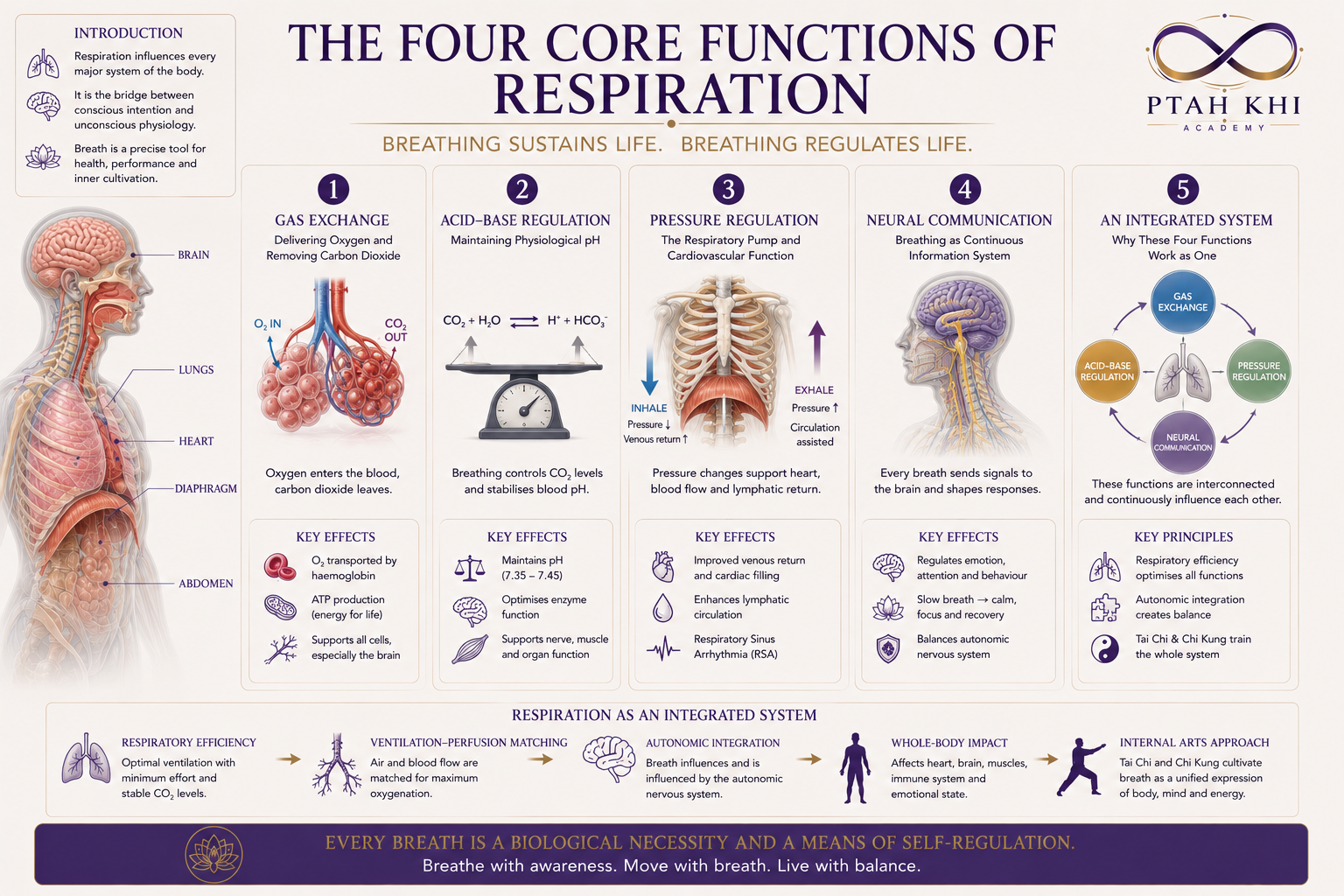
The Four Core Functions of Respiration
Introduction
Respiration is often reduced to the simple exchange of oxygen and carbon dioxide. While gas exchange is undoubtedly essential, modern physiology recognises that breathing performs numerous interconnected functions that influence every major system of the human body. Respiration regulates cellular metabolism, maintains biochemical homeostasis, supports cardiovascular function, influences brain activity, modulates the autonomic nervous system and continuously informs the brain about the body’s internal condition.
For practitioners of Tai Chi, Chi Kung and internal cultivation, breathing is therefore far more than a means of sustaining life. It is the bridge between conscious intention and unconscious physiology. Every breath alters mechanical forces, blood chemistry, neural signalling and emotional regulation. Understanding these processes allows breathing to become a precise therapeutic tool rather than an automatic bodily function.
Although respiration serves many specialised roles, four core physiological functions underpin all others.
1. Gas Exchange — Delivering Oxygen and Removing Carbon Dioxide
The primary purpose of respiration is to maintain the exchange of gases between the atmosphere, the lungs and the bloodstream. This process occurs within approximately 300 million alveoli, creating an enormous respiratory surface area of around 70–100 square metres—roughly the size of half a tennis court.
When air reaches the alveoli, oxygen diffuses across the thin alveolar-capillary membrane into the pulmonary capillaries. At the same time, carbon dioxide diffuses from the blood into the alveoli to be expelled during exhalation. This passive diffusion occurs because gases naturally move from areas of higher partial pressure to lower partial pressure.
Once oxygen enters the bloodstream, approximately 98% binds to haemoglobin within red blood cells, while a small proportion dissolves directly into plasma. Haemoglobin transports oxygen throughout the body, releasing it into tissues where it is required for aerobic metabolism.
Inside the mitochondria, oxygen serves as the final electron acceptor during oxidative phosphorylation. This process enables the production of adenosine triphosphate (ATP), the universal energy currency that powers muscle contraction, nerve conduction, protein synthesis, immune defence and virtually every biological process.
Carbon dioxide is produced as a natural consequence of aerobic metabolism. Rather than being merely a waste product, CO₂ performs numerous essential physiological functions, including regulating blood pH, influencing blood flow to the brain and helping determine respiratory drive.
Without continuous oxygen delivery, ATP production rapidly declines, forcing cells into inefficient anaerobic metabolism and resulting in lactic acid accumulation. Because neurons possess exceptionally high metabolic demands and limited energy reserves, the brain is particularly vulnerable to oxygen deprivation. Permanent neurological injury may begin after approximately four to six minutes of complete oxygen deprivation.
From an internal arts perspective, efficient breathing is therefore not simply about “taking in more oxygen.” It is about optimising the mechanics of ventilation so that oxygen delivery, carbon dioxide regulation and cellular energy production occur with maximum efficiency and minimum unnecessary muscular effort.
2. Acid–Base Regulation — Maintaining Physiological pH
One of the most important yet least appreciated functions of respiration is maintaining acid–base homeostasis.
The body functions optimally only within an extremely narrow blood pH range of approximately 7.35–7.45. Even relatively small deviations from this range can impair enzyme activity, alter nerve conduction, disrupt muscle contraction and compromise organ function.
Carbon dioxide plays a central role in this regulatory system. When CO₂ combines with water, it forms carbonic acid through the following reversible reaction:
CO₂ + H₂O ⇌ H₂CO₃ ⇌ H⁺ + HCO₃⁻
This buffering system allows respiration to rapidly influence blood acidity.
When breathing becomes excessively rapid (hyperventilation), carbon dioxide is expelled faster than it is produced. Blood CO₂ falls, hydrogen ion concentration decreases and blood becomes more alkaline, producing respiratory alkalosis. Symptoms may include dizziness, tingling sensations, visual disturbances, muscle tension and reduced cerebral blood flow.
Conversely, when ventilation becomes insufficient (hypoventilation), carbon dioxide accumulates. Hydrogen ion concentration rises, producing respiratory acidosis. Severe acidosis may impair cardiovascular function, depress nervous system activity and reduce consciousness.
Unlike the kidneys, which require hours to days to regulate pH, the respiratory system can make significant corrections within seconds or minutes. This makes breathing the body’s fastest mechanism for maintaining acid–base balance.
Modern breathing interventions therefore influence physiology not through mystical mechanisms but through measurable changes in carbon dioxide concentration, autonomic regulation and acid–base chemistry.
For practitioners of Tai Chi and Chi Kung, slow diaphragmatic breathing encourages greater respiratory efficiency without unnecessary hyperventilation, allowing the body to maintain an optimal balance between oxygen availability and carbon dioxide retention.
3. Pressure Regulation — The Respiratory Pump and Cardiovascular Function
Breathing is also a powerful mechanical process that supports circulation.
During inhalation, contraction of the diaphragm enlarges the thoracic cavity and reduces intrathoracic pressure. This negative pressure assists venous blood returning from the abdomen and lower limbs towards the right atrium of the heart. During exhalation, pressure changes assist blood movement through the pulmonary circulation and influence left ventricular filling.
Together these pressure changes form the respiratory pump—an often overlooked mechanism that significantly assists cardiovascular efficiency.
The diaphragm should therefore be viewed not only as the principal muscle of respiration but also as an important circulatory muscle.
Breathing also influences lymphatic circulation. Unlike the cardiovascular system, the lymphatic system possesses no central pump. Instead, lymph movement depends largely upon skeletal muscle contraction, arterial pulsation and respiratory pressure changes. Deep diaphragmatic breathing therefore assists immune surveillance, fluid balance and waste removal by promoting lymphatic return.
Respiration also influences heart rate through Respiratory Sinus Arrhythmia (RSA). During inhalation, heart rate naturally accelerates slightly. During exhalation, heart rate slows. This phenomenon reflects healthy vagal regulation and is considered an important marker of autonomic flexibility and cardiovascular resilience.
Numerous clinical studies have demonstrated that slow breathing—typically around five to six breaths per minute—can improve baroreflex sensitivity, increase heart rate variability (HRV), reduce sympathetic nervous system activity and contribute to reductions in resting blood pressure.
These physiological responses explain why breathing exercises have become recognised adjunctive therapies in hypertension management, cardiac rehabilitation and stress-related disorders.
Within Tai Chi and Chi Kung, diaphragmatic breathing naturally enhances these cardiovascular mechanisms while reducing unnecessary muscular tension throughout the thorax, abdomen and neck.
4. Neural Communication — Breathing as a Continuous Information System
Perhaps the most fascinating function of respiration is its role as a continuous communication network between the body and the brain.
Every breath generates thousands of sensory signals that travel through the vagus nerve, phrenic nerve, glossopharyngeal nerve and spinal pathways towards the brainstem. Additional information arises from stretch receptors within the lungs, mechanoreceptors in the diaphragm and intercostal muscles, chemoreceptors monitoring oxygen, carbon dioxide and pH, and baroreceptors monitoring blood pressure.
These signals converge primarily within the nucleus tractus solitarius (NTS) in the medulla, where they are integrated before being transmitted to higher brain centres including the hypothalamus, amygdala, insular cortex, anterior cingulate cortex and prefrontal cortex.
Consequently, breathing continuously shapes emotional regulation, attention, memory, pain perception, immune activity and behavioural responses.
Fast, irregular breathing increases sympathetic activation and prepares the organism for defensive action.
Slow, rhythmic diaphragmatic breathing enhances parasympathetic activity through vagal pathways, promoting recovery, digestion, tissue repair, emotional stability and cognitive flexibility.
Research has further demonstrated that respiratory rhythms influence neural oscillations within widespread cortical networks. Breathing synchronises activity within structures involved in memory, emotional processing and attention, illustrating that respiration acts not merely as ventilation but as a neural timing mechanism.
For practitioners of internal arts, this represents one of the physiological foundations for meditative breathing. By consciously altering respiratory rhythm, individuals intentionally modify afferent neural signalling to the brain, influencing both physiological regulation and psychological state.
Breath therefore becomes an instrument through which conscious awareness can interact directly with otherwise unconscious regulatory systems.
Key Principle
Breathing is far more than the movement of air into and out of the lungs. It is a multidimensional physiological process that simultaneously regulates energy production, acid–base chemistry, cardiovascular dynamics and neural communication. Every conscious breath influences the body mechanically, chemically, electrically and neurologically. In the internal arts, mastery of breathing begins with recognising that each breath is both a biological necessity and a powerful means of self-regulation.