

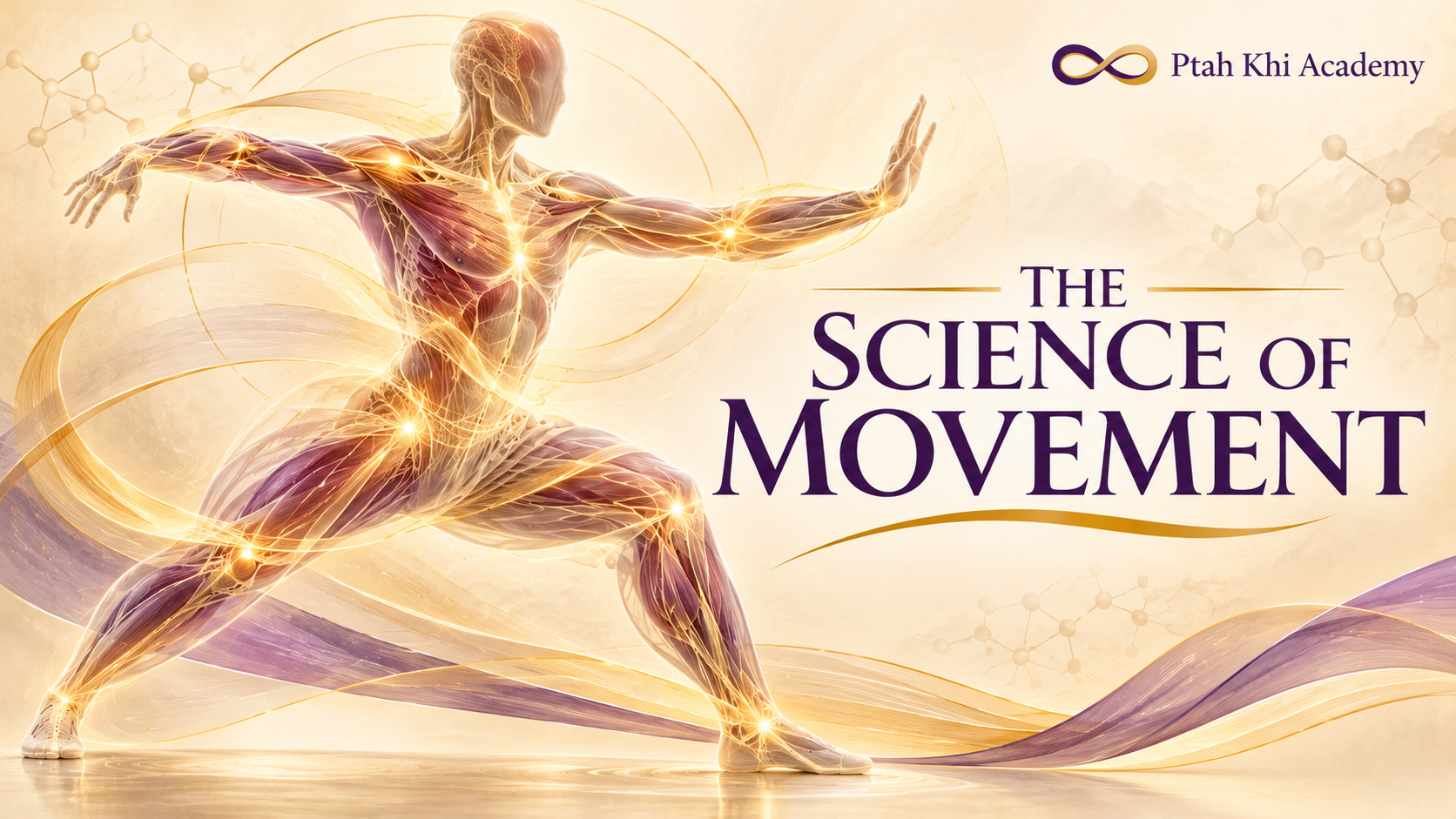
About Course
Welcome to the Science of Movement
Movement is one of the most fundamental expressions of life. From the smallest adjustments in posture to the complex coordination involved in walking, running, swimming and martial arts, the human body is constantly organising, adapting and responding to its environment. Yet how much do we really understand about what happens beneath the surface when we move?
The Science of Movement takes you on an exploration of the human body, bringing together the principles of sports and exercise science, biomechanics, functional anatomy, neuroscience and traditional movement knowledge. It examines how the body works as an interconnected system, exploring the relationships between the brain, nervous system, muscles, fascia, joints, connective tissues and the sensory mechanisms that allow us to coordinate and adapt our movements.
Throughout the course, we explore four fundamental patterns of movement: Linear Motion, Contralateral Movement, Ipsilateral Movement and Sequential Motion. These provide a foundation for understanding how different parts of the body work independently and together, how forces travel through the body, and how coordinated movement develops through interconnected physical structures.
However, movement is not simply a mechanical process. It involves a continuous relationship between the physical body, the nervous system, sensory awareness and the environment. Through exploring biomechanics, proprioception, interoception, balance, posture and motor control, we begin to understand how the body senses, organises and refines movement, often without conscious thought.
Alongside modern scientific understanding, the course introduces traditional perspectives on movement, including the principles of Chi, internal coordination and the relationship between physical structure, breath and energetic awareness. These perspectives offer another way of investigating how movement has been understood and developed through traditional practices such as Tai Chi Chuan and Chi Kung, whilst allowing us to consider where traditional observations and contemporary scientific explanations intersect.
From everyday activities to athletic performance and internal martial arts, the same fundamental principles of movement can be observed in different forms. By recognising these connections, we can develop a deeper appreciation of how the human body functions, adapts and responds to the demands placed upon it.
Ultimately, the Science of Movement is about more than learning how the body moves. It is about understanding why it moves the way it does, how its different systems communicate and cooperate, and how greater awareness of these processes can influence the way we approach physical activity, movement quality and our relationship with the body.
As you progress through the course, you will be encouraged to question, investigate and connect the information, developing a more informed understanding of movement through both scientific enquiry and traditional knowledge.
Welcome to the Science of Movement: where ancient wisdom meets modern understanding.
Course Content
Course Introduction
Module 1: Understanding the Science of Movement
Module 2: Understanding Movement Types
Module 3: Structural Layers of Movement
Module 4: The Holistic Integration of Motion
Module 5: Applying the Science to Practice
Module 6: The Science of Integrated Movement
Final assessment and course completion
Course Conclusion
Earn a certificate
Add this certificate to your resume to demonstrate your skills & increase your chances of getting noticed.
Student Ratings & Reviews

No Review Yet
