


Ptah Khi combines traditional internal arts knowledge with contemporary research from neuroscience, physiology, movement science and health science to explore how movement, breath and awareness influence human performance and wellbeing.
Ptah Khi combines traditional internal arts knowledge with contemporary research from neuroscience, physiology, movement science and health science to explore how movement, breath and awareness influence human performance and wellbeing.


The Ptah Khi School was built on the conviction that traditional internal arts and contemporary neuroscience, physiology, and psychophysiology do not contradict each other they confirm each other. Every practice in the system has both a classical explanation and a modern scientific one. Both are taught. Neither is optional.
Ancient wisdom and modern science are not in conflict. They are two languages describing the same reality.
The Ptah Khi approach recognises that human development has been explored through many forms of knowledge throughout history. Traditional internal arts provide a deep understanding of movement, breath, awareness and cultivation, while modern science provides methods to investigate measurable physiological, neurological and psychological processes.
Rather than separating these perspectives, Ptah Khi explores how they can complement each other to create a more complete understanding of the human system.
For thousands of years, internal arts traditions have explored the relationship between body, breath, mind and consciousness.
The Ptah Khi framework draws from:
Chi Kung
Practices focused on cultivating internal energy, regulating the body, refining breath and developing awareness through movement.
Tai Chi
An internal martial art exploring balance, coordination, relaxation, structure and the integration of movement with awareness.
Nei Kung
Internal training methods focused on developing deeper body awareness, strength, resilience and refinement of internal practice.
Nei Dan
Internal cultivation practices exploring transformation, consciousness, mindfulness and the relationship between body and mind.
These traditional systems provide a framework for understanding human potential through disciplined practice and direct experience.
Contemporary research provides tools to investigate how movement, breathing and attention influence human physiology.
Ptah Khi connects with research fields including:
Neuroscience
Exploring brain function, neuroplasticity, attention, learning and the relationship between movement and the nervous system.
Physiology
Examining how practices influence systems such as respiration, cardiovascular function, stress response and regulation.
Psychology
Understanding emotional regulation, wellbeing, resilience and the relationship between mind and body.
Movement Science
Studying biomechanics, posture, balance, coordination and how humans learn and adapt through movement.
Modern research continues to expand our understanding of how mind-body practices interact with human biology.
The Ptah Khi approach explores the human system as an interconnected whole.
Through the relationship between:
Movement
Developing physical awareness, coordination, balance and functional capability.
Breath
Supporting regulation, relaxation, awareness and connection between body and mind.
Awareness
Developing attention, presence and deeper understanding of internal experience.
Regulation
Exploring the ability of the human system to adapt, recover and maintain balance.
This integrated perspective creates a bridge between traditional internal arts and contemporary research exploring the human being as a dynamic connection of body, mind, energy and consciousness.
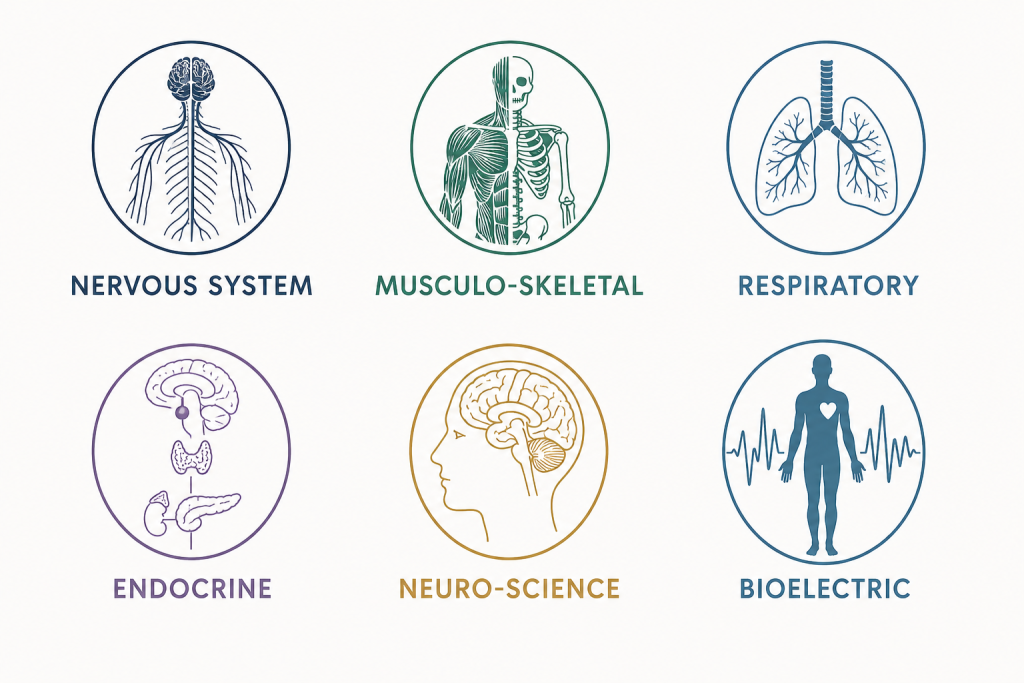
SIX BODY SYSTEMS
The Ptah Khi System follows a progressive developmental structure in which each stage builds upon the previous one. The practitioner develops through a clear internal pathway from physical refinement toward expanded awareness.
Nervous System
Every Tai Chi and Chi Kung practice in the system produces a measurable shift in autonomic nervous system state — from sympathetic dominance (stress, tension, reactivity) toward parasympathetic recovery (calm, clarity, repair). This is not a metaphor. It is physiology, and it is the most immediate and consistently experienced benefit of the practice.
Slow diaphragmatic breathing directly stimulates the vagus nerve — the primary parasympathetic pathway. Grounded posture reduces proprioceptive threat signals to the amygdala. Yi-directed movement activates interoceptive awareness circuits. Combined, these produce a measurable improvement in Heart Rate Variability within a single session.
VAGUS NERVE
POLYVAGAL THEORY
HRV IMPROVEMENT
SYMPATHETIC TONE
The body’s fascial network and the connective tissue surrounding every muscle, organ, and nerve may hold chronic tension patterns that restrict movement, perpetuate pain, and signal stress throughout the nervous system. Tai Chi’s structural training systematically releases these patterns through progressive alignment, weight transfer, and spinal coordination.
HOW THE PTAH KHI SYSTEM WORKS ON THIS SYSTEM: Skeletal stacking and postural alignment distribute load through the fascial tensegrity network rather than concentrating it in muscles. Slow movement trains proprioceptive feedback loops, improving joint position awareness and motor control. The Wave Movement and spinal coordination sequences specifically target fascial release along the posterior chain.
FASCIA
PROPRIOCEPTION
KINETIC CHAIN
MOTOR CONTROL
Breath is the only autonomic function under conscious control and therefore the master key to nervous system regulation. Diaphragmatic breathing, breath-movement synchronisation, and CO₂ tolerance training improve oxygen efficiency, calm the stress response, and create the internal regulation that makes the transition from physical to energy practice possible.
Layer Two of the Ptah Khi system is entirely devoted to breath. Lower dantien breathing develops full diaphragmatic function. The 4-7-8 protocol and extended exhalation training specifically target parasympathetic activation. Breath-movement synchronisation in the Tai Chi form integrates respiratory awareness into every physical action.
DIAPHRAGMATIC BREATH
CO₂ TOLERANCE
RSA
BREATH-MOVE SYNC
Long-term internal arts practice produces measurable reductions in baseline cortisol, improvements in immune function, and enhanced emotional resilience. The limbic system, the brain’s emotional processing centre is directly influenced by the breath and movement practices in the system. Emotions are not managed through the Ptah Khi system they are metabolised.
Five Element Chi Kung specifically targets the organ-emotion relationships, Lung (grief), Kidney (fear), Liver (anger), Heart (joy), Spleen (worry). The Inner Smile practice cultivates a baseline state of emotional neutrality. Nei Dan practices work directly with the Three Treasures to transform emotional energy at its source rather than suppressing it.
CORTISOL MODULATION
LIMBIC SYSTEM
EMOTIONAL RESILIENCE
HRV IMPROVEMENT
Consistent practice of slow, deliberate, intention-led movement creates the same neural firing patterns as full physical execution and over time produces lasting structural changes in the brain. Grey matter density increases in regions governing attention, emotional regulation, and self-awareness. The Default Mode Network associated with rumination and anxiety shows measurable reduction in activity.
Yi (intention) training the deliberate direction of attention through movement is the practice mechanism for motor cortex activation. Layer Four’s witnessing meditation directly targets Default Mode Network suppression. The 369 System’s progressive Nine Stages create the long-term structural neural change that distinguishes genuine development from short-term stress relief.
VAGUS NERVE
GREY MATTER
DEFAULT MODE NETWORK
META-AWARENESS
Postural alignment directly affects neurological signalling throughout the body. The kinetic chain from foot through spine to crown determines how efficiently the nervous system communicates, how much energy is consumed in basic movement, and how available the body is for internal cultivation. Ground connection is not metaphorical it is mechanoreceptive and measurable.
Wu Ji standing posture and rooting exercises specifically activate mechanoreceptors in the feet and ankles the proprioceptive anchor that determines global postural tone. Skeletal stacking reduces chronic muscular holding by distributing gravitational load through bone rather than soft tissue. Nei Kung structural training refines this efficiency to its highest possible expression.
MECHANORECEPTION
BIO-TENSEGRITY
KINETIC CHAIN
ENERGY CONSERVATION
The following evidence tables summarise the current research supporting Tai Chi and Chi Kung for specific conditions. Research ratings reflect the strength and volume of evidence available.
Scientific research varies in strength depending on the number of studies available, research design and level of scientific investigation. The Evidence Strength guide below helps explain the current level of research supporting each area.
★★★★★ Strong Evidence
Multiple high-quality studies, systematic reviews or meta-analyses.
★★★★☆ Good Evidence
Clinical research with consistent findings.
★★★☆☆ Emerging Evidence
Promising findings but more research needed.
★★☆☆☆ Exploratory Evidence
Early investigation or developing understanding.
★☆☆☆☆ Traditional / Developing Framework
Traditional knowledge systems or areas where modern research is still developing.
| CONDITION | EVIDENCE SUMMARY | RATING | RELEVANCE TO PTAH KHI |
| Anxiety | Multiple RCTs demonstrate significant anxiety reduction comparable to medication for mild-moderate presentations. Vagal stimulation through slow breathing is the primary mechanism. | STRONG | Layer 2 breath work and Layer 4 witnessing practice are directly targeted at anxiety’s physiological root. |
| Depression | Meta-analyses show Tai Chi as effective for reducing depressive symptoms, particularly in older adults and those with chronic illness. Physical activation combined with social engagement are key factors. | STRONG | The Wednesday live class provides both the movement intervention and the social connection component that makes the evidence work. |
| Chronic Stress | Regular practice reduces baseline cortisol, improves HRV, and builds long-term stress resilience. Effects persist beyond the practice session — an important distinction from acute relaxation techniques. | STRONG | The Ptah Khi system’s emphasis on daily practice through the Six Daily Activities maximises long-term stress resilience outcomes. |
| Panic Attacks | Breath regulation training directly addresses the physiological triggers of panic — hyperventilation and sympathetic overdrive. CO₂ tolerance training reduces panic susceptibility over time. | GOOD | Lower dantien breathing and extended exhalation protocols from Layer 2 are the direct intervention mechanism. |
| Poor Sleep | Chi Kung practice improves sleep quality, reduces insomnia, and regulates circadian rhythms. Parasympathetic activation before bed is the primary mechanism. | GOOD | Evening practice timing — as in the Wednesday 7pm session — is specifically effective for sleep quality improvement. |
| PTSD | Emerging evidence for trauma-sensitive movement practices. Body-based regulation approaches show promise where cognitive therapies have limitations. Somatic awareness training is the mechanism. | EMERGING | The Ptah Khi system’s interoceptive approach — awareness of internal sensation — aligns with trauma-informed somatic practice principles. |
| CONDITION | EVIDENCE SUMMARY | RATING | RELEVANCE TO PTAH KHI |
| Fall Prevention | WHO and NICE both recommend Tai Chi as the most effective fall prevention intervention for older adults. Balance improvement is consistent across all major studies. Evidence is the strongest in the field. | STRONG | Rooting and weight transfer training from Week 2 directly addresses the proprioceptive deficits that cause falls. Wu Ji standing develops vestibular stability. |
| Chronic Pain | Tai Chi reduces pain intensity and disability across musculoskeletal conditions including osteoarthritis, fibromyalgia, and chronic back pain. Central sensitisation reduction through mindful movement is the mechanism. | STRONG | Fascial release through structural training and nervous system regulation combine to address both the physical and neurological components of chronic pain. |
| Knee Rehabilitation | Strengthens supporting musculature, improves proprioception, and reduces pain without impact loading. Particularly effective post-physiotherapy for maintaining and extending gains. | GOOD | Documented in Ptah Khi student outcomes. Camilo’s case — knee rehabilitation following injury — demonstrates the clinical application directly. |
| Hypertension | Tai Chi produces clinically significant reductions in systolic and diastolic blood pressure across multiple trials. Endorsed by the British Heart Foundation as a recommended lifestyle intervention. | STRONG | The combination of breath regulation, postural release, and stress hormone reduction addresses all three primary mechanisms of hypertension simultaneously. |
| Balance Disorders | Vestibular system training through slow movement dramatically reduces fall risk. Evidence is particularly strong for older adults and those with Parkinson’s disease | STRONG | Single-leg weight transfer drills, Wu Ji standing, and the Tai Chi form’s continuous weight shift are directly targeted vestibular training. |
| Hip Flexibility | Ba Duan Jin specifically produces measurable improvement in hip flexor mobility and range of motion. Particularly effective for sedentary adults and those with desk-based occupations. | GOOD |
Ba Duan Jin is a core component of both access program and the Chi Gong, instructor certification directly documented in student outcomes |
| CONDITION | EVIDENCE SUMMARY | RATING | RELEVANCE TO PTAH KHI |
| Type 2 Diabetes | Tai Chi improves insulin sensitivity, HbA1c levels, and general metabolic function as part of a lifestyle intervention. Particularly effective combined with dietary modification. | GOOD | The Health & Longevity programme will specifically address metabolic health as one of its primary outcome areas. |
| Cardiovascular Disease | Regular practice improves cardiovascular efficiency, reduces resting heart rate, and supports cardiac rehabilitation. British Heart Foundation endorses Tai Chi as a cardiac rehabilitation activity. | STRONG | The autonomic regulation mechanisms specifically HRV improvement and reduced sympathetic tone directly benefit cardiovascular function. |
| Post-Covid Recovery | Breath regulation and gentle movement address fatigue, breathlessness, and anxiety characteristic of Long Covid. An area of rapidly growing NHS social prescribing referral. | EMERGING | The Wednesday live class format, accessible online, gentle intensity, breath-led is specifically suited to post-Covid recovery needs. |
| Arthritis | Arthritis Research UK endorses Tai Chi. NICE guidelines recommend it for osteoarthritis of the hip and knee. Low-impact joint mobilisation combined with muscular strengthening is the mechanism. | STRONG | The non-impact nature of Tai Chi movement means all practices are accessible to those with active arthritic conditions without exacerbating inflammation. |
| Chronic Fatigue | Gentle movement with breath regulation improves energy levels in CFS/ME without triggering post-exertional malaise, a key distinction from higher-intensity exercise interventions.
|
GOOD | The graded approach of the Ptah Khi system, beginning with posture and breath before progressing to movement this is inherently appropriate for fatigue conditions. |
| CONDITION | EVIDENCE SUMMARY | RATING | RELEVANCE TO PTAH KHI |
| Parkinson’s Disease | NICE guidelines cite Tai Chi as the most effective exercise intervention for balance and motor control in Parkinson’s disease. Consistent evidence across multiple trials. The slow, deliberate movement is the mechanism. | STRONG | The Ptah Khi system’s emphasis on slow, intention-led movement — Yi practice — is directly aligned with the mechanisms that produce Parkinson’s outcomes. |
| Cognitive Decline | Evidence suggests Tai Chi practice slows cognitive decline in older adults. Dual-task training — coordinating movement with attention — is the proposed mechanism for cognitive preservation. | GOOD | The complexity of Tai Chi forms — requiring sustained attention, spatial memory, and coordination — constitutes a cognitively demanding dual-task practice. |
| Neuroplasticity | Long-term practitioners show increased grey matter density in regions governing attention and emotional regulation. Deliberate slow movement and meditative focus are the mechanisms for structural brain change. | GOOD | The progressive Nine Stages of the 369 System are specifically designed to create the long-term, sustained practice that produces structural neuroplastic change. |
| ADHD | Emerging evidence for mind-body practices in attention regulation. The grounded, sequenced nature of Tai Chi form practice provides both a focus anchor and a physical channel for excess energy. | EMERGING | The progression from physical structure through breath to awareness in the Ptah Khi layers is a natural developmental arc for attention regulation. |
Scientific evidence develops at different levels depending on the amount of research available, the quality of studies conducted and the consistency of findings.
The Ptah Khi approach presents research transparently, recognising areas with established evidence alongside emerging fields of investigation. Evidence strength reflects the current scientific research landscape and does not represent the value or depth of a traditional practice.
| Research Area | Current Understanding | Evidence Strength |
| Balance & fall prevention | Research suggests Tai Chi may support improvements in balance, postural control and functional mobility, particularly in older adults. | ★★★★★ Strong Evidence |
| Systems involved | Nervous system regulation, musculoskeletal function, proprioception and motor control. | |
| Evidence type | Clinical trials, systematic reviews and meta-analyses. | |
| Practical application | Supports movement confidence, coordination and functional independence. |
| Research Area | Current Understanding | Evidence Strength |
| Stress response | Mind-body practices involving movement, breathing and attention may support stress regulation, relaxation and emotional wellbeing. | ★★★★☆ Good Evidence |
| Systems involved | Autonomic nervous system, endocrine system, respiratory system and psychological processes. | |
| Evidence type | Clinical research, physiological studies and behavioural research. | |
| Practical application | Stress management, self-regulation and improved wellbeing. |
| Research Area | Current Understanding | Evidence Strength |
| Breathing practices | Controlled breathing practices may influence respiratory function, autonomic activity and relaxation responses. | ★★★★☆ Good Evidence |
| Systems involved | Respiratory system, nervous system and cardiovascular regulation. | |
| Evidence type | Physiological research and clinical studies. | |
| Practical application | Breath awareness, relaxation and improved regulation. |
| Research Area | Current Understanding | Evidence Strength |
| Brain adaptation & learning | Movement-based mindfulness practices are being investigated for their relationship with attention, learning, neuroplasticity and cognitive function. | ★★★☆☆ Emerging Evidence |
| Systems involved | Brain networks, nervous system, cognition and motor learning systems. | |
| Evidence type | Neuroscience research, behavioural studies and emerging clinical investigation. | |
| Practical application | Focus, awareness, skill development and cognitive wellbeing. |
| Research Area | Current Understanding | Evidence Strength |
| Movement efficiency | Internal arts training explores posture, coordination, sensory feedback and efficient movement patterns. | ★★★☆☆ Emerging Evidence |
| Systems involved | Musculoskeletal system, nervous system, sensory processing and motor control. | |
| Evidence type | Movement science, biomechanics research and motor learning studies. | |
| Practical application | Body awareness, coordination and movement refinement. |
The following research areas represent examples of the growing scientific investigation into Tai Chi, Chi Kung and related mind-body practices.
Movement, Balance & Falls
Research has explored Tai Chi as a movement practice that may influence balance, postural control and functional mobility.
Research focus:
Evidence strength: ★★★★★ Strong Evidence
Stress, Anxiety & Emotional Wellbeing
Studies have investigated how movement, breathing and attention-based practices may influence psychological wellbeing and stress regulation.
Research focus:
Evidence strength: ★★★★☆ Good Evidence
Neuroscience & Cognitive Function
Research into movement-based awareness practices explores connections between attention, learning and brain adaptation.
Research focus:
Evidence strength: ★★★☆☆ Emerging Evidence
Physiological Regulation
Scientific investigation continues into how controlled movement and breathing practices influence measurable physiological processes.
Research focus:
Evidence strength: ★★★★☆ Good Evidence
The field of internal arts research continues to evolve. Ptah Khi recognises the value of both traditional wisdom and modern scientific inquiry, creating a framework where movement, breath, awareness and human development can be explored through multiple perspectives.


NHS & CLINICAL RECOGNITION
The evidence base for Tai Chi and Chi Kung has moved beyond academic research into formal clinical recommendation. The following organisations have endorsed internal arts practice as a clinically relevant intervention.
NICE issues UK clinical guidelines recommending Tai Chi for falls prevention, osteoarthritis and Parkinson’s disease management based on evidence reviews across health and care settings in England.
National Health Service operationalises care through social prescribing and commissioning pathways, enabling Tai Chi and Chi Kung referrals for mental health, musculoskeletal conditions and long-term condition self-management in community settings.
Endorses Tai Chi as a cardiac rehabilitation activity. Recommends for hypertension management and cardiovascular health maintenance.
Endorses Tai Chi specifically for osteoarthritis of the hip and knee. Recommends as a first-line movement intervention.
Recommends Tai Chi as the most effective fall prevention intervention globally. Included in WHO physical activity guidelines for older adults.
Movement-based practices that integrate breath, awareness, and gentle physical activity represent one of the most evidence-supported and accessible interventions available to social prescribing link workers. — NHS ENGLAND SOCIAL PRESCRIBING FRAMEWORK, 2024
The Ptah Khi School does not treat science and tradition as competing frameworks. Each practice is taught with both its classical context and its modern scientific understanding, so practitioners know not just what to do but why it works.
Every practice is introduced within its classical context — the lineage it comes from, the principles it embodies, and its place within the Ptah Khi five-layer framework. Ancient systems encode millennia of refined empirical observation.
The modern neurological, physiological, and psychophysiological understanding of the practice is then presented — not to replace the classical explanation, but to confirm it in a language that contemporary students and clinical partners understand.
Ultimately, the proof is in the body of the practitioner. All theory and all science point toward the same destination — the lived, felt, embodied experience of genuine internal development. This is what the Ptah Khi system delivers.
The Ptah Khi School uses the WEMWBS (Warwick-Edinburgh Mental Wellbeing Scale) as its primary outcome measurement tool — the same standard used by the NHS to document and demonstrate the impact of the system on student wellbeing.
The Research and Institutions Hub within the Ptah Khi knowledge portal maintains an active library of peer-reviewed research curated and updated to reflect the most current evidence supporting internal arts practice.
Through NHS partnerships and institutional relationships, the Ptah Khi School actively participates in the clinical ecosystem, contributing to the growing evidence base for internal arts as a mainstream health intervention.
GLOBAL RECOGNITION
The evidence base for Tai Chi and Chi Kung is global. Research programmes across four continents have independently confirmed the clinical benefits of internal arts practice — making this one of the most internationally validated movement-based health interventions available.
🇬🇧
NICE · NHS · BHF · ARC
Clinical guidelines recommend Tai Chi for falls, arthritis, Parkinson’s, and cardiovascular rehabilitation. Social prescribing framework actively promotes referrals.
🇺🇸
United States
HARVARD MEDICAL SCHOOL · NIH
Harvard Medical School has produced extensive Tai Chi research. NIH National Center for Complementary and Integrative Health funds ongoing research programmes.
🇨🇳
China
MINISTRY OF HEALTH · WHO COLLABORATING CENTRES
The origin of the practice. State-endorsed health intervention. WHO Collaborating Centres for Traditional Medicine maintain extensive research archives.
🇦🇺
Australia
NHMRC · AUSTRALIAN INSTITUTE OF SPORT
National Health and Medical Research Council has funded multiple high-quality trials. Particularly strong evidence for falls prevention in aged care settings.

THE EVIDENCE IS CLEAR
The science supports what practitioners have known for centuries. The Ptah Khi system integrates both — giving every student access to the full depth of the tradition and the full confidence of the evidence. Explore the courses to experience both for yourself.
Take the first step…
All is one and everything is one.
We’re here to help! Whether you’re curious about the curriculum, courses, programs, or how Tai Chi can transform your life, reach out to us today.
